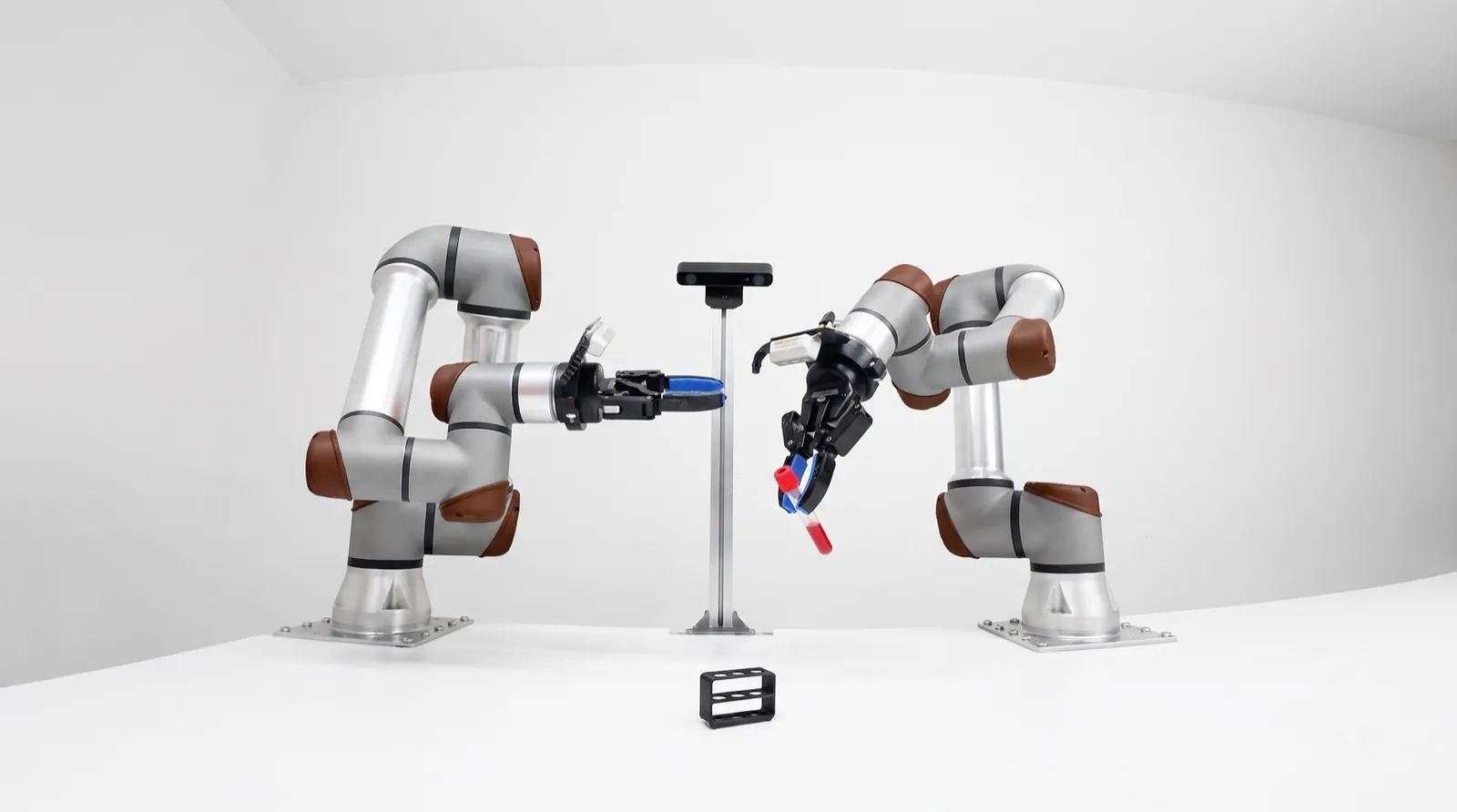
Bin-picking integrators, 2026
Who builds vision-guided picking cells, how they differ and how to choose one.
Relling builds the picking cell around your parts and bins, qualified before it ships.
Leanings, not rules. From the use-case table on this page.
What a bin-picking integrator actually does
A bin-picking cell is an arm plus 3D vision, grasp planning, a matched gripper and a placement step, tuned to your parts and bins.

Read the full section
A bin-picking system is more than a robot arm. It is a robot arm plus 3D vision that sees into the bin, grasp planning that decides where and how to pick, a gripper matched to the part, and a placement step that puts the part where it needs to go. A bin-picking integrator is the firm that combines those pieces and tunes them for your specific parts, bins, and cycle time — so a jumbled pile becomes a reliable stream of correctly placed parts.
The field is not uniform. Some vendors sell perception software only — the 3D-vision-and-grasp layer that an integrator or OEM drops into a larger cell — while others build the full cell, owning the arm, vision, gripper, and control together. You typically need an integrator (or a pre-engineered cell) when you are automating high-SKU or cluttered picking that a fixtured feeder can't economically present one part at a time — the harder and more variable the bin, the more the perception and grasp planning have to do.
Six things to compare before you shortlist
The same spec sheet lets you compare any two integrators fairly.
Proven on your line
Qualified before it ships
Your floor tied upFactory acceptance test (FAT) at the integrator
What the FAT should prove
- Picks per hour on your parts, not a demo part
- Grasp success and mis-pick recovery
- The hand-off to your line or WMS
Read the full section
Bin type
Structured, single-orientation presentation is a comparatively simple vision problem. Fully random, overlapping clutter demands high-quality 3D perception and grasp planning that can find a pick in a pile. Confirm the integrator's depth in your bin.
SKU range & generalization
A fixed set of parts can be tuned once. A constantly changing mix rewards systems whose grasping generalizes to shapes they weren't explicitly taught, so a new SKU isn't a new project.
3D vision & perception
Sensor resolution and robustness to lighting, reflective, and transparent parts decide whether the system can even see a viable pick. This is the layer some vendors sell on its own.
Grasp planning & gripper
How the system chooses a collision-free grasp, and whether the gripper — suction, finger, or hybrid — matches your parts. Delicate, deformable, or mixed parts stress this most.
Cycle time / picks-per-hour
Throughput depends on part, clutter, gripper, and vision cycle time. Benchmark picks-per-hour on your actual parts and bins rather than a vendor's demo part.
Integration & error recovery
How the cell ties into your line or WMS, and what happens on a mis-pick — retry, flag, human-in-the-loop, or stop. Recovery is where a picking cell earns its uptime.
Five categories of bin-picking integrator
Most firms sit mainly in one category, so knowing which you need narrows the field fast.
| Category | Best for | Strengths | Trade-offs |
|---|---|---|---|
| Full-stack cell builders | Turnkey picking cells | Own the vision, control, and gripper together; qualified as a system | Less mix-and-match; you buy the whole cell |
| Perception / vision software vendors | Integrators building their own cell | Deep 3D perception and grasp software as a drop-in layer | You still need arm, gripper, and integration |
| Intelligent-controller platforms | High-throughput, controller-driven picking | Real-time motion planning with perception, no teach-points | Newer paradigm; validate on your parts |
| Logistics / parcel picking specialists | Induction and sortation at scale | Built for parcel and each-picking volume; human-in-the-loop options | Tuned for logistics, not manufacturing parts |
| Robot-OEM + vision | Standardized picking on OEM arms | Own robots, service, spares; proven arm platforms | Perception often paired from a third party |
Table scrolls horizontally on small screens →
Nine bin-picking integrators, compared
Listed alphabetically, not ranked; Relling publishes this guide and is marked as such.
| Company | HQ | Category | Known for | Best for |
|---|---|---|---|---|
| Ambi Robotics | Berkeley, CA | Logistics / parcel | AmbiSort AI parcel sortation | AI-driven parcel sortation and induction |
| Apera AI | Vancouver, BC | Perception / vision SW | Software-defined 4D vision using standard cameras; fast deployment | Vision-guided picking with rapid deployment |
| Fizyr | Delft, NL | Perception / vision SW | Deep-learning vision for pick-and-place of unknown, unpredictable items | Integrators needing a robust vision-software layer |
| Mujin | Tokyo, JP / Suwanee, GA | Intelligent controller | Intelligent controller pairing real-time motion planning with 3D perception | High-throughput, controller-driven picking systems |
| OSARO | San Francisco, CA | Perception / piece-picking | ML perception and control for piece-picking and automated packaging | E-commerce piece-picking and packaging |
| Photoneo (a Zebra company) | Slovakia | Perception / 3D vision | High-resolution 3D cameras and Bin Picking Studio software | 3D-vision-led bin picking and as a perception layer |
| Plus One Robotics | San Antonio, TX | Logistics / parcel | PickOne AI vision with human-in-the-loop remote supervision | Parcel and logistics picking at scale |
| Relling | United States | Full-stack AI cell | Physical-AI picking cell; closed-loop 3D vision, learned grasping, qualified off-site | High-mix picking deployed in weeks |
| RightHand Robotics | Boston (Charlestown), MA | Piece-picking | RightPick hardware-plus-software for order-fulfillment each-picking | Broad-SKU each-picking in fulfillment |
Table scrolls horizontally on small screens →
Four worth knowing well
Mujin, Plus One, Photoneo and Relling, in more depth.
Read the full section
Mujin — the intelligent controller
Mujin makes an intelligent robotics controller that pairs real-time motion planning with 3D perception, driving robots without conventional teach-point programming. Its particular strength is high-throughput piece-picking and de-palletizing where cycle time and reliability matter. Choose it when throughput is the priority and you want a controller-driven approach rather than a hand-taught cell; as with any newer paradigm, validate on your actual parts and bins.
Plus One Robotics — parcel picking with a human in the loop
Plus One pairs its PickOne AI vision engine with human-in-the-loop remote supervision, so an operator can resolve the edge cases the vision system flags rather than stopping the line. It is a leader in parcel induction and de-palletizing at logistics scale. Choose it when the picking task is really an induction-and-sortation problem at parcel volume and you value a supervised-autonomy safety net.
Photoneo — the 3D vision layer
Photoneo (a Zebra company) makes high-resolution 3D cameras and its Bin Picking Studio software, widely adopted by integrators as the perception layer of a picking cell. It is the clear specialist when 3D vision quality is the deciding factor and you or your integrator are assembling the rest of the cell around it. Choose it when perception is your hardest problem and you want a proven vision building block rather than a full turnkey system.
Relling — physical-AI, full-stack, high-mix
Relling builds an AI-native picking workcell for exactly the varied, cluttered bins that fixtured feeding can't economically handle. Closed-loop 3D vision and learned grasping find and adapt to each part, so a new SKU is a software reconfiguration rather than new tooling and a re-teach; cells are scoped and qualified off-site and stand up on a US floor in weeks, with verification on every pick rather than sampling. It fits high-mix shops that want adaptive picking without a months-long integration project. We include ourselves here for completeness and describe our cell on the same terms as the rest of the field.
Which type fits your operation
Match the company type to your parts, bins and volume.
| If your situation is… | Look at… | Why |
|---|---|---|
| Parcel / logistics induction | Plus One or Ambi Robotics | Built for parcel induction and sortation at scale |
| Broad-SKU each-picking fulfillment | RightHand Robotics | RightPick tuned for wide-catalog order-fulfillment picking |
| Manufacturing turnkey picking cell | Relling | Full-stack AI cells that own vision, control, and gripper together |
| Need a vision layer for your own integration | Photoneo or Fizyr | Perception software and 3D vision as a drop-in building block |
| High-throughput, controller-driven picking | Mujin | Real-time motion planning with perception, no teach-points |
Ten questions to ask any bin-picking integrator
Ask these before you sign, and compare the answers with the flags below.
Read the full section
- How structured is my bin, and have you picked from clutter like it?
- How wide is the SKU range you can handle, and does grasping generalize?
- How robust is the 3D vision to lighting, reflective, or transparent parts?
- What is your grasp-success rate, and how do you recover from a mis-pick?
- What picks-per-hour can I expect on my actual parts, not a demo part?
- What gripper strategy do you use — suction, finger, or hybrid?
- How does the cell integrate with my line or WMS?
- Is the system qualified before it ships, or proven on my floor?
- Where is your nearest service tech, and what is the response SLA?
- What is the all-in cost — cell, vision, gripper, install, training, spares?
Frequently asked questions
Do I need an integrator, or can I buy a bin-picking robot directly?
You can buy a robot arm and 3D camera directly, but a bare arm and sensor are not a working picking cell. An integrator combines the arm, 3D vision, grasp planning, gripper, and placement, then tunes and qualifies the system against your parts and bins. First-time and high-mix buyers almost always work with an integrator or buy a pre-engineered cell; large operations with in-house perception and robotics teams sometimes integrate themselves, often using a perception-software vendor as one layer.
How much does a bin-picking cell cost in 2026?
As a rough industry guide, a robotic bin-picking cell often runs about $80,000–$250,000 or more, depending on the quality of the 3D vision, the throughput required, the gripper and grasp complexity, and how deeply it integrates with your line or WMS. Perception software licensed on its own sits lower; full turnkey cells with high throughput and error recovery sit at the upper end. Always price against your specific parts, bins, and cycle-time targets.
What is the difference between structured and random bin picking?
Structured bin picking presents parts in a known, orderly arrangement — single layer, consistent orientation, or a fixture — so the vision and grasp problem is comparatively simple. Random bin picking deals with parts jumbled and overlapping in unknown orientations, where the system must find a viable pick in a pile and plan a collision-free grasp on the fly. Random, cluttered bins demand higher-quality 3D perception and grasp planning and are what separates the more capable systems.
How fast is robotic bin picking?
Picks-per-hour vary widely with part geometry, bin clutter, gripper type, and vision cycle time. Simple, well-separated parts with a fast controller can reach high rates; deeply cluttered bins of reflective or deformable parts are slower because each grasp must be found and verified. Always benchmark picks-per-hour on your actual parts and bins rather than a demo part.
Can bin picking handle reflective, deformable, or mixed parts?
Increasingly yes, but these are exactly the cases that stress a system. Reflective and transparent parts challenge 3D vision; deformable items challenge grasp planning and gripper choice; mixed bins challenge generalization across shapes the system wasn't explicitly taught. The right vision quality, gripper strategy, and learned grasping matter most here — validate performance on your hardest parts before committing volume.
How do I choose between the companies listed here?
Match the firm to your work: how structured your bin is, how wide your SKU range runs, whether you want a full turnkey cell or just a perception layer for your own integration, your throughput target, and who stands behind the cell on your floor. Ask for reference installations similar to your parts, clarity on qualification before ship, mis-pick recovery, and a defined response plan for downtime.
Editorial buyer's guide compiled by Relling for manufacturers evaluating vision-guided bin-picking automation. Integrators are listed alphabetically and are not ranked; inclusion is not an endorsement and is not paid. Company details (headquarters, ownership, product lines) are drawn from public information and current as of publication — verify specifics, current pricing, and capabilities directly with each vendor. Relling is the publisher and is described on the same criteria as the other firms.
Choosing a bin-picking integrator? Let Relling handle it
We match the vision and gripper to your parts, build the picking cell and qualify it before it ships.
- Book a 30-minute call on the parts and the bins
- We match the camera and gripper to your parts and cycle
- We deliver the cell, qualified before it ships