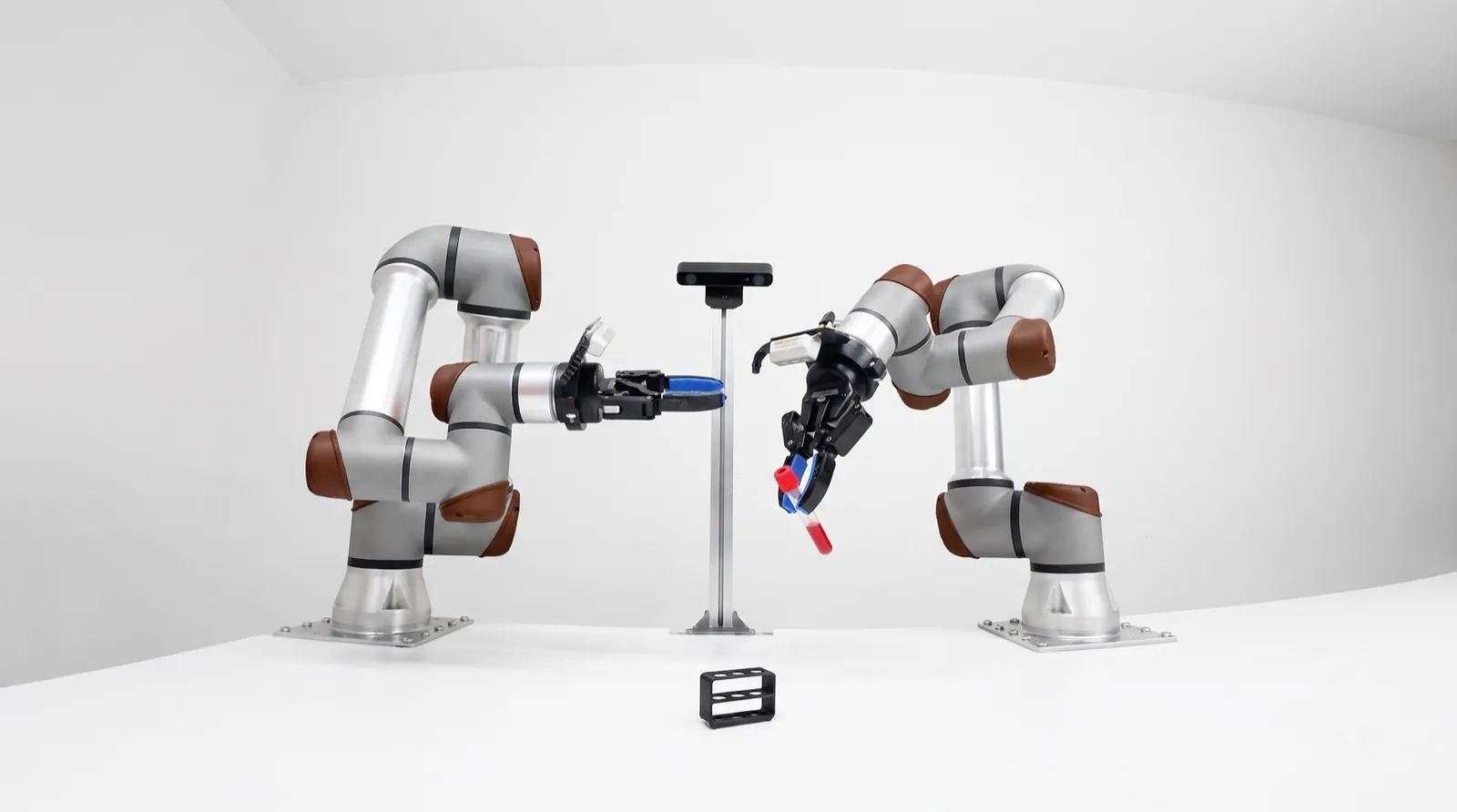
Best autonomous mobile robots, 2026
Which AMR fits your loads and your floor, in a vendor-neutral comparison.
Relling builds the cell your AMRs feed, so transport and handling run as one flow.
Leanings, not rules. The right AMR depends on payload, role and your floor.
The specs that actually matter for AMRs
An AMR is judged on how well it fits your loads, layout and software, more than on raw speed.
AGV: a fixed path
Follows tape, wires or reflectors, and stops when something blocks it.
AMR: a planned path
Maps the floor with SLAM and onboard sensors, and routes around obstacles and people.
Read the full section
Payload
The heaviest load the robot carries, from a few kilograms for tote and shelf robots up to 1,900 kg on the heaviest pallet platform compared here (OTTO 1500). Size it to your worst case, not your average.
Navigation
How the robot finds its way. Modern AMRs use SLAM and natural-feature mapping to plan their own paths; older AGV-style systems follow magnetic tape or wires on fixed routes.
Throughput & fleet size
One robot rarely matters. What counts is picks or moves per hour across a coordinated fleet, and how many robots the traffic manager can run in your space.
Form factor
Tote, cart, pallet, or piece-pick. The chassis and lift decide what the robot can carry and how it hands off to people or fixed equipment.
Fleet management software
The traffic controller and task allocator that keeps robots from colliding, balances work, and manages charging. Often the real differentiator between platforms.
Safety & human environments
Safety-rated scanners, speed and separation, and certification decide whether robots can share aisles with people rather than run behind fencing.
The AMR categories
Four categories cover most jobs, from light totes to heavy pallets.
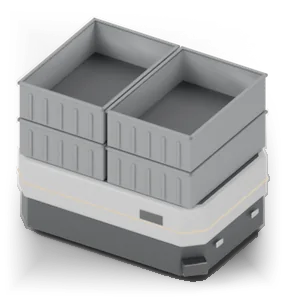
Light tote/shelf
Totes and bins
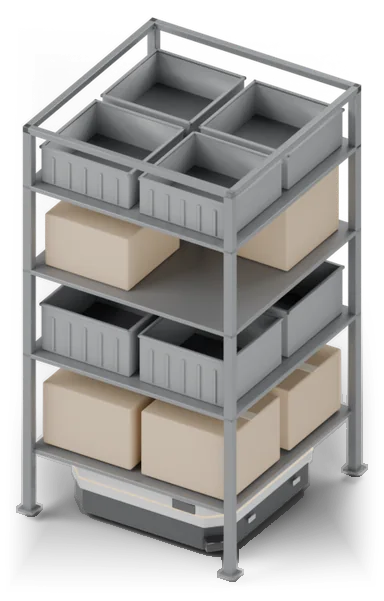
Goods-to-person
Shelf and rack loads
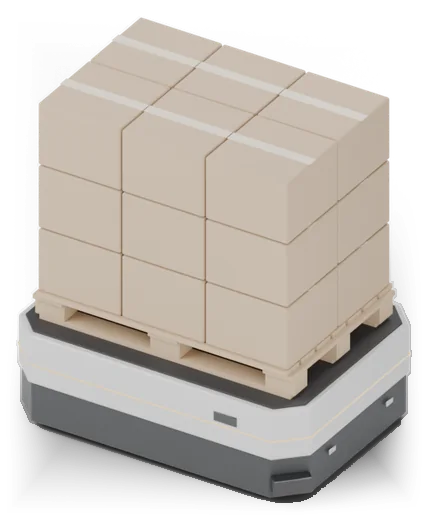
Pallet/heavy
Up to 1,900 kg (OTTO)
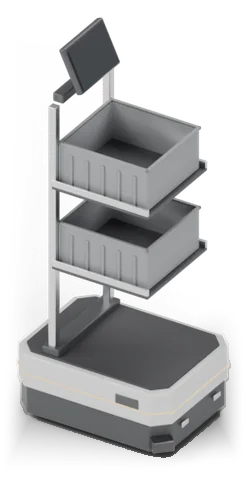
Piece-picking
Cart or tote
Read the full section
| Category | Payload | Role | Best for |
|---|---|---|---|
| Light tote/shelf AMRs | Tote and bin loads | Move totes, bins, and shelves | Light transport, first automation |
| Goods-to-person AMRs | Shelf / rack loads | Bring inventory to pick stations | Storage and retrieval, fulfillment |
| Pallet/heavy AMRs | Up to 1,900 kg (OTTO 1500) | Move pallets and heavy loads | Industrial material transport |
| Piece-picking mobile systems | Cart / tote | Guide or assist pickers to items | High-volume e-commerce fulfillment |
The AMR platforms, side by side
Manufacturer-published specs, listed alphabetically by vendor and not ranked.
| Platform | Vendor | Payload | Role | Best for |
|---|---|---|---|---|
| Chuck (formerly 6 River Systems) | Ocado | Cart | Collaborative fulfillment carts | Warehouse pick assist |
| Geek+ | Geek+ | Shelf / rack | Goods-to-person & sortation | Storage, retrieval, and sorting |
| inVia Robotics | inVia | Tote | RaaS goods-to-robot picking | Low-capex flexible fulfillment |
| Locus Robotics | Locus | Cart / tote | Piece-fulfillment AMRs | E-commerce piece-picking at scale |
| MiR | Mobile Industrial Robots / Teradyne | 250–1,350 kg | Industrial transport | Tote and pallet transport between cells |
| OTTO Motors | Rockwell | 150–1,900 kg | Heavy material transport | Heavy in-plant pallet moves |
| Vecna Robotics | Vecna | Pallet / tote | Pallet/tote handling & tuggers | Mixed pallet and tugger workflows |
Table scrolls horizontally on small screens →
Four platforms worth knowing well
MiR and OTTO for plant transport, Locus for fulfillment picking, Geek+ for goods-to-person and sortation.
Read the full section
MiR: the industrial AMR transport leader
MiR (Mobile Industrial Robots, part of Teradyne) is the default for industrial material transport, with a range that spans the 250 kg MiR250 up to 1,350 kg pallet platforms and a mature fleet manager that coordinates mixed fleets across a plant. The ecosystem of top modules, shelf lifts, and pallet hooks lets one platform family cover many transport jobs, which is why it is a common first AMR for manufacturers moving totes and carts between cells.
OTTO Motors: heavy in-plant transport
OTTO Motors (part of Rockwell Automation) specializes in heavier material transport, with platforms rated up to 1,900 kg (OTTO 1500) for pallets and large loads on busy plant floors. The tie to Rockwell's automation stack and a fleet manager built for high-traffic industrial environments make it a common choice where the job is moving heavy loads reliably alongside people and forklifts.
Locus Robotics: fulfillment piece-picking at scale
Locus builds collaborative fulfillment AMRs that guide human pickers through a warehouse, carrying totes and consolidating orders so people walk less and pick more. It is deployed at large scale in e-commerce and retail distribution, typically under a robotics-as-a-service model, and is known for driving measurable units-per-hour gains without re-racking the building.
Geek+: goods-to-person and sortation
Geek+ is a broad AMR vendor whose goods-to-person robots bring shelves and racks to pick stations, paired with sortation robots that route parcels and orders. The range spans light picking to heavier storage and sortation, making Geek+ a common choice for operations that want storage, retrieval, and sorting from one supplier.
Which AMR fits your job
Start from the load and the role: transport, goods-to-person or picking.
Read the full section
| If you… | Consider… | Why |
|---|---|---|
| Move totes or carts between cells | MiR, OTTO Motors | Proven industrial transport at tote and cart scale |
| Move heavy pallets | OTTO Motors, Vecna Robotics | OTTO platforms carry up to 1,900 kg |
| Run e-commerce fulfillment picking | Locus Robotics, Ocado Chuck (formerly 6 River Systems) | Collaborative piece-picking that scales with orders |
| Want goods-to-person storage | Geek+, inVia Robotics | Bring inventory to stations instead of walking to it |
| Need low-capex, flexible automation | RaaS (inVia) | Subscription pricing avoids up-front capital outlay |
An AMR is a fleet, not a point solution
One robot rarely delivers the outcome; the fleet software and integration around it do.
Safety plan · safety-rated scanners and rules for aisles shared with people
Read the full section
A single robot rarely delivers the outcome. To move real work an AMR needs fleet management software that assigns tasks and controls traffic, WMS/MES integration so robots act on live orders and production signals, charging and infrastructure to keep the fleet running, and a safety plan for shared aisles with people. Buying one robot is not the same as deploying a working system.
That is why AMR projects are scoped as fleets and integrations, not individual machines. For the tasks a fixed robot performs instead, see our robot task guides; for who designs and installs these systems, see our kitting and goods-to-person integrator guide.
Ten questions to ask before choosing an AMR
Settle these before you pick a platform.
Read the full section
- What payload and form factor do my loads actually require?
- What navigation type does it use: SLAM/natural-feature or fixed-path?
- What fleet size and throughput does my operation need?
- How capable is the fleet-management software at traffic and tasking?
- Does it integrate cleanly with my WMS or MES?
- What charging and infrastructure does the fleet require?
- Is it safety-rated to run in aisles shared with people?
- How well does the platform scale as I add robots and zones?
- What is the all-in cost: per-unit purchase or RaaS subscription?
- Where is service, and what is the support and response plan?
Frequently asked questions
What is the best AMR in 2026?
There is no single best AMR. The right platform depends on payload, role, and environment. For industrial material transport, MiR and OTTO Motors lead. For e-commerce and warehouse fulfillment, Locus Robotics, Geek+, and Ocado's Chuck (formerly 6 River Systems) lead. The best choice depends on the payload you move and whether your job is transport, goods-to-person, or piece-picking.
What is an AMR and how is it different from an AGV?
An autonomous mobile robot (AMR) navigates autonomously using SLAM, natural-feature mapping, and onboard sensors, so it can plan its own path and route around obstacles and people. An automated guided vehicle (AGV) follows a fixed path defined by magnetic tape, wires, or reflectors and stops when something blocks it. AMRs are more flexible and easier to reconfigure; AGVs are simpler and can be lower-cost for fixed, repetitive routes.
What payload do AMRs carry?
AMR payloads range from a few kilograms for light tote and shelf robots up to 1,900 kg on the heaviest pallet platform compared here (OTTO 1500). Match the platform to the heaviest load and the form factor (tote, cart, pallet, or piece-pick) your operation requires.
How are AMR fleets managed?
AMR fleets are coordinated by fleet-manager software that assigns tasks, plans traffic, and manages charging, integrated with your WMS or MES so the robots act on real orders and production signals. The quality of that software and its integration often matters more than any single robot's specs.
How much do AMRs cost?
AMRs can be bought per unit as a capital purchase, or deployed under a robotics-as-a-service (RaaS) subscription that bundles the robots, fleet software, and support into a recurring operational fee. RaaS lowers up-front capex and is common for fulfillment picking; per-unit purchase is common for fixed industrial transport.
What are AMRs used for?
AMRs are used for material transport between cells and areas, goods-to-person storage and retrieval, e-commerce and warehouse fulfillment picking, and line-side delivery in manufacturing. They move totes, carts, and pallets so people and fixed equipment do not have to.
Editorial buyer's guide compiled by Relling for manufacturers evaluating autonomous mobile robots. Platforms are listed alphabetically by vendor, not ranked; inclusion is not an endorsement. Specifications are nominal manufacturer-published figures and vary by variant. Verify current datasheets and pricing directly with each manufacturer. Relling builds turnkey manipulation cells that AMRs can feed and is described on that basis.
Moving loads to a robot cell? Let Relling handle it
We build the manipulation cell your AMRs feed, so transport and handling run as one flow.
- Book a 30-minute call on the loads and the cell
- We plan how totes, carts and pallets reach the cell
- We deliver the cell, qualified before it ships