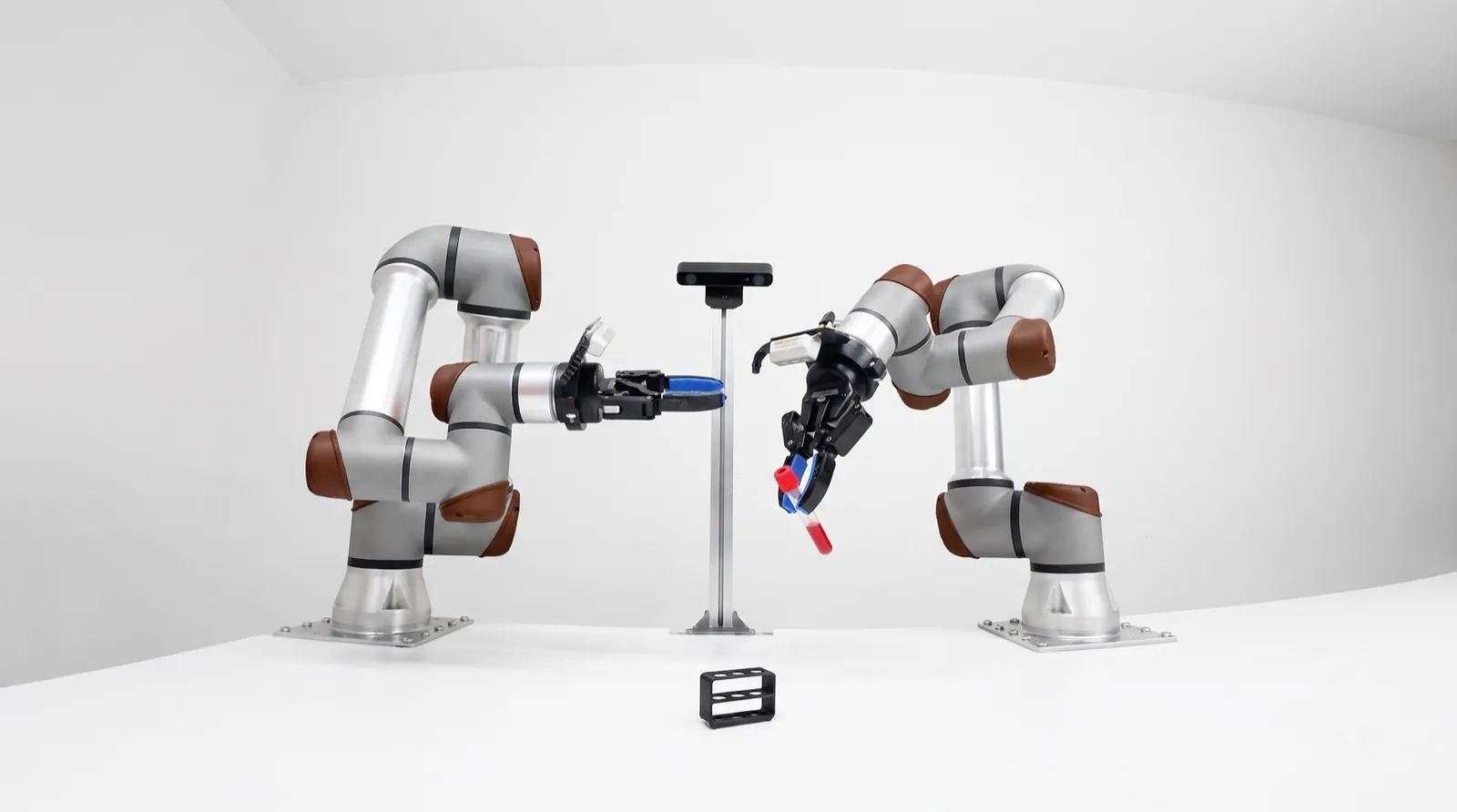
Best robots for kitting & picking, 2026
Which picking arm or mobile robot fits your kits and SKU count, compared without a favourite brand.
Relling builds the picking cell with vision and gripper and delivers it working.
Leanings, not rules. Grasping or moving decides; we build the cell for your SKUs.
The specs that actually matter for kitting
Kitting is decided by SKU variety and throughput on your parts, not by the arm’s datasheet.
Read the full section
SKU range & item variability
The defining spec. How many distinct items, and how varied in size, shape, weight, and deformability? Broad, ML-trained vision generalizes across tens of thousands of SKUs; rigid teach-based systems do not.
Picks per hour
Throughput on your parts, not the datasheet's. Vendors quote up to about 1,000 picks per hour for broad-SKU picking systems; item geometry, gripper, and error recovery move the number more than the arm does.
Reach & payload (arm)
For a picking arm, reach must cover the source bins and kit tray, and payload must cover the heaviest item plus gripper — commonly 5–12 kg at the wrist for typical kitting parts.
Gripper/EOAT & vision
The end effector and 3D vision decide what can actually be picked. Vacuum, finger, and multi-modal grippers each suit different items; 3D vision (Photoneo, Zivid) locates and orients each piece.
Fixed cell vs mobile (AMR)
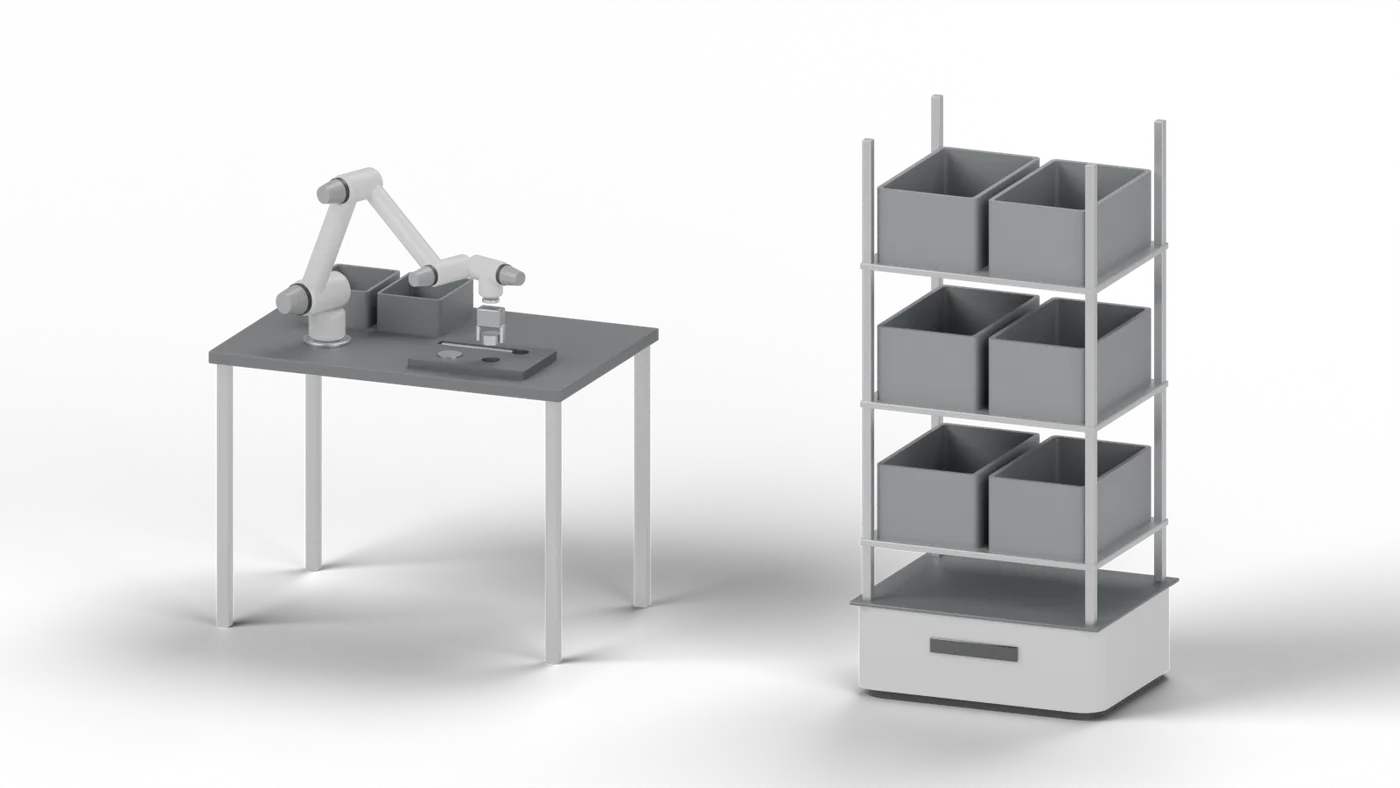
A fixed picking cell grasps items in place; a goods-to-person AMR moves inventory to the point of use and picks nothing. This choice — grasp vs transport — drives the whole architecture.
WMS/MES integration
Kitting is orchestration as much as motion. The robot or fleet must talk to your WMS/MES for order data, inventory, and sequencing — integration depth often decides real-world success.
Picking arms or mobile robots
Picking arms grasp and place each item; goods-to-person AMRs move inventory to where it is picked.
Read the full section
| Category | Role | Strength | Best for |
|---|---|---|---|
| Robotic piece-picking arms | Grasp and place individual items | Physical each-picking into a kit | Assembling kits at a station across many SKUs |
| Piece-picking systems (arm+vision) | Turnkey arm, 3D vision, and gripper | Broad-SKU picking out of the box | High-mix each-picking without in-house integration |
| Goods-to-person AMRs | Bring totes, shelves, or carts to a person/cell | Eliminating walking, scaling to huge catalogs | Large fulfillment and feeding picking stations |
| Robotics-as-a-service | Robots and software on a subscription | Low capex, flexible scaling | Variable volume, avoiding upfront investment |
Kitting & picking robots, side by side
Picking arms, picking systems and AMR fleets, with nominal specs.
| Product | Type | Key spec | Note | Best for |
|---|---|---|---|---|
| FANUC LR Mate 200iD | Arm | 7 kg / 0.72 m | Compact 6-axis arm; pair with 3D vision | Precise, small-footprint kitting cells |
| RightHand Robotics RightPick | System | Arm + vision piece-picking | ML vision + smart gripper, broad-SKU | High-mix each-picking out of the box |
| Universal Robots UR12e | Cobot | 12.5 kg / 1.3 m | Flexible base; pair with 3D vision (Photoneo/Zivid) | Flexible kit assembly at a station |
| Geek+ | AMR | Goods-to-person | Shelf- and tote-to-person fleets | Bringing parts to a person or robot |
| Locus Robotics | AMR | Piece-fulfillment | Collaborative bots that guide pickers | Piece-fulfillment at scale |
| inVia Robotics | AMR / RaaS | Goods-to-robot | Subscription robotics-as-a-service | Low-capex, flexible goods-to-robot picking |
| OTTO Motors / Rockwell | AMR | Material transport | Moves totes and carts between areas | Transporting inventory across the floor |
Table scrolls horizontally on small screens →
Read the full section
Note on arms: the picking arms above (FANUC LR Mate, UR12e) are not vision systems on their own — they pair with 3D vision such as Photoneo or Zivid to locate and orient each item before grasping. RightHand RightPick bundles the arm, vision, and gripper as one system.
Four systems worth knowing well
RightPick for broad-SKU picking, Locus and Geek+ for AMR fulfillment, and a UR12e with 3D vision for kits at a station.
Read the full section
RightHand Robotics RightPick — broad-SKU each-picking
RightPick pairs an industrial arm with machine-learning vision and a multi-modal gripper, purpose-built to pick individual items across a very broad SKU range without teaching each one. It generalizes to tens of thousands of items and reports pick success in the high-90s on trained catalogs, which is why it is a common choice for high-mix each-picking and kit assembly where item variability would defeat a rigid, teach-based cell.
Locus Robotics — AMR fulfillment at scale
Locus deploys fleets of collaborative mobile robots that guide human pickers through orders, cutting the walking that dominates manual fulfillment and raising pick rates several-fold. It scales to very large operations and integrates with the WMS to sequence work. Locus does not grasp items itself — people (or a picking cell) do the picking — so it excels at piece-fulfillment throughput rather than each-picking dexterity.
Geek+ — goods-to-person AMR
Geek+ brings inventory to the operator: robots retrieve shelves or totes and deliver them to a picking station, eliminating walking and scaling to large catalogs because the robot moves inventory rather than grasping it. In a kitting context, a goods-to-person fleet feeds the right bins to a station where a person or a picking arm assembles the kit — the AMR handles transport, not the pick.
UR12e + 3D vision — flexible kit assembly at a station
A Universal Robots UR12e paired with 3D vision (Photoneo or Zivid) and a suitable gripper is a common building block for a flexible kitting cell: the vision locates and orients each item, and the cobot places it into the kit tray. The easy teach-and-play programming and deep ecosystem make it approachable for shops without robotics staff, at the cost of speed versus a dedicated industrial cell.
Which robot fits your job
Start from whether the robot must grasp items or move them.
Read the full section
| If you… | Consider… | Why |
|---|---|---|
| Build kits at a station | Picking arm + vision (UR12e / LR Mate / RightPick) | You need to grasp and place each item into the kit |
| Bring parts to a person or robot | Goods-to-person AMR (Geek+ / inVia) | Move inventory to the point of use, not grasp it |
| Run a large fulfillment operation | Locus Robotics | Piece-fulfillment throughput at scale |
| Want low capex and flexibility | Robotics-as-a-service (inVia) | Subscription pricing, scale up or down without capital |
| Move totes or carts between areas | Transport AMR (OTTO) | Material transport across the floor, no picking |
A robot is not a kitting system
A kitting system also needs 3D vision, a matched gripper and WMS orchestration.
Read the full section
A picking arm from the list above is just an arm. To build kits from production parts it needs 3D vision to locate items, a gripper or EOAT matched to your parts, and WMS orchestration to sequence orders and inventory — integrated and qualified as one system. The arm is often a fraction of the total cost of a working kitting cell.
An AMR fleet is not a system on its own either: it needs a fleet manager to coordinate the robots and integration with your WMS/MES to know what to move and where. That is why most manufacturers buy a pre-engineered cell or fleet, or work with an integrator or turnkey provider, rather than bare robots. If you're comparing who builds those systems, see our companion guide to kitting & sequencing integrators.
Ten questions to ask before choosing a kitting robot
Settle these before you pick a robot.
Read the full section
- What is my SKU range, and how variable are the items in size and shape?
- What picks-per-hour do I actually need on my parts, not the datasheet's?
- Do I need a picking arm to grasp items, or an AMR to move inventory?
- What gripper and 3D vision does it use, and can they handle my items?
- How does it integrate with my WMS/MES for orders and inventory?
- What is the pick accuracy, and how does it recover from errors?
- How does it scale as volume or SKU count grows?
- What footprint does the cell or fleet require on my floor?
- What is the all-in cost beyond the robot itself?
- Where is service, and what is the spare-parts and response plan?
Frequently asked questions
What is the best robot for kitting in 2026?
There is no single best kitting robot — it depends on the job. To assemble kits at a station across many SKUs, a piece-picking arm with 3D vision and a smart gripper (e.g. RightHand RightPick, or a UR12e / FANUC LR Mate paired with Photoneo or Zivid vision) is the right tool. To bring parts to a person or robot, a goods-to-person AMR fleet (Geek+, inVia) is the better fit. Most operations combine both, so match the robot to the task rather than looking for one winner.
Do I need a picking arm or an AMR for kitting?
A picking arm physically grasps individual items to build a kit — you need one when the robot must select and place each piece. A goods-to-person AMR does not pick items; it moves totes, shelves, or carts so parts reach a person or a picking cell. Many kitting operations use both: AMRs deliver the right bins to a station, and an arm (or a person) assembles the kit. Decide by whether the bottleneck is grasping items or moving inventory to the point of use.
How accurate and fast is robotic kitting?
Modern piece-picking arms with 3D vision typically achieve pick success rates in the high-90s percent on trained SKUs and run at up to about 1,000 picks per hour by vendor figures, depending on item variability and gripper. Goods-to-person AMR systems raise operator pick rates several-fold by eliminating walking. Real numbers depend heavily on SKU mix, item geometry, and error-recovery handling, so pilot on your own parts before committing to a rate.
How many SKUs can a kitting robot handle?
Piece-picking systems built on machine-learning vision can generalize across tens of thousands of SKUs without per-item teaching, though highly deformable, transparent, or tangled items remain hard. Goods-to-person AMR systems scale to very large catalogs because the robot moves inventory rather than grasping it. The practical limit is set less by the robot and more by item variability, gripper range, and how gracefully the system handles exceptions.
How much does a robotic kitting system cost?
A single robotic kitting cell — arm, 3D vision, gripper, and integration — commonly runs about $100,000–$300,000 or more depending on throughput and complexity. Goods-to-person AMR systems are usually priced per robot plus software, or offered as robotics-as-a-service with a monthly fee and little upfront capital. Price against SKU count, throughput, and whether you want to own the system or subscribe.
Should I buy the robots or work with a systems integrator?
A picking arm is not a kitting system on its own — it needs vision, grippers, and WMS orchestration — and an AMR fleet needs a fleet manager and integration with your WMS/MES. Unless you have an in-house automation team, most manufacturers buy a pre-engineered cell or fleet through an integrator or turnkey provider that delivers the robots as a qualified, running kitting system rather than a bare arm or bare AMRs.
Editorial buyer's guide compiled by Relling for manufacturers evaluating kitting and piece-picking robots and AMRs. Products are grouped by category and listed alphabetically, not ranked; inclusion is not an endorsement. Specifications are nominal manufacturer-published figures and vary by variant — verify current datasheets and pricing directly with each manufacturer. Relling builds turnkey kitting cells and is described on that basis.
Not sure which kitting robot? Let Relling handle it
We build the picking cell with vision and gripper matched to your SKUs and qualify it before it ships.
- Book a 30-minute call on the part and the cell
- We match the gripper and vision to your parts
- We deliver the cell, qualified before it ships